Monday, 14 April 2014

lambing

Given the normal gestation of sheep , the first possible date for lambing should have been  4 days hence  ( friday, today being monday).
So it was a bit of a surprise  at 6am going and seeing the ewe to find a head protruding.


Nothing for it but to  get on , I suppose.
The first one was the normal presentation with the feet extended. So its 'just a matter of' waiting until enough has appeared that you can get hold of, and then pulling in a downward direction.


 and about 20 minutes later mother and first  lamb are doing well.


So a bit of a wait for the second one .
About an hour later she started  contracting again. but this time there was a head and instead of the legs being straight out in front, they were bent back at the elbow joint.

Hmmm - a  malpresentation and time to send for help .

So with some help and advice from a local farmer  the position  was converted to  the normal one  and then we had 2 lambs.


 So 2 lambs. And according to the local expert, they are both a good size , in spite of the ram being a small Boreray. So 2 large lambs and an elderly ewe is the likely cause of the toxaemia.

And the toxaemia has interrupted the  production of milk, so at the moment the ewe has no milk and we are starting to bottle-feed the youngsters.
 As the lambs are likely to  have been born early the advice is to keep mother and lambs inside for a couple of days.

Hopefully this wont all prove too much for the ewe,


Sunday, 13 April 2014

A poorly ewe.


And Zena hasn't been herself for the last few days . Off food, listless, lying down a lot.
The consensus (Robbie down the hill, and the vet) seems to be that she has toxaemia.

And as ever , google is your friend for finding out about stuff. Toxaemia in sheep is different to toxaemia (pre-eclampsia) in people . In sheep its due to lack of calories in to keep up with the needs of rapidly growing lambs lambs in utero, which grow the most in the last 6 weeks.  It is worse in ewes carrying twins, adn the consensus is that she has at least 2 in there. The mother cannot keep up with the energy requirements of the  growing lambs, so she develops a low blood sugar and starts breaking down body stores of energy , which produces ketones.  Her current Body Condition Score ( a method of assessing nutritional status) is 2, according to Robbie.

The specific treatment is delivery of the lambs , and the vet can induce labour if necessary . In sheep its steroids , whilst in people its oxytocin that is used.

In the meantime its a matter of trying to keep up the energy intake.
So the suggestions are
-grain instead of sheep feed ( Zena has been  spontaneously eating  the poultry grain )
-feed with carbohydrates . (Suggestions include Ready-brek mixed with molasses)
But it is necessary to stimulate the rumen , as sheep  need to ruminate their food to digest protein and carbohydrate. And yoghurt mixed with carbohydrate has been suggested for this.

According to our sums  the earliest we could be lambing is in 5 days time.

And once delivered , this problem should go.

And we thought your onw  children were anxiety-generating !


Friday, 11 April 2014

Dropping ?


When you compare this picture of Zena with one taken a few weeks ago , we think her shape has changed .  Previously the pregnancy was symmetrical in her abdomen, now it seems it  isn't.

This could be the ovine equivalent of 'lightening' in women, when the pregnant uterus moves down into the pelvis.  Its called dropping in lambing circles and is listed here as a sign that lambing is imminent.


Watch this space

Wednesday, 9 April 2014

Tuesday, 8 April 2014

Eggs, anyone ?


So , long days as we are past the equinox. Maturing hens .
And so yesterday the crop was 17 eggs.

methings reduced rations for a few days , to try and discourage them

Sunday, 6 April 2014

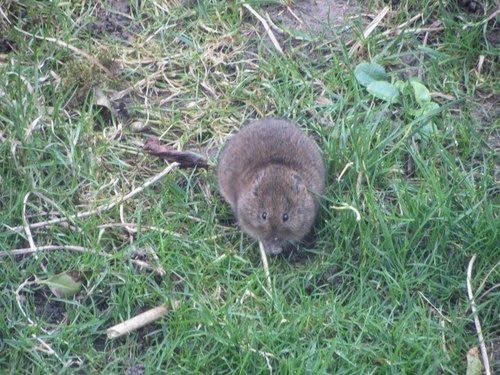
Orkney Vole


We saw this from the kitchen window one morning. Its an orkney vole.


They are unique to the Islands of  Rousay, Mainland (thats us!), Sanday, Westray and South Ronaldsay.


Having read about it , it is related to the common vole but its ears are  larger and they have shorter, paler brown fur.

The subspecies was introduced to the islands 5,000 years ago, possibly on the boats of Neolithic settlers.


thay have shallow burrows and  one website says they can be found in ruined buildings, so its possibly all  the stone walls that attracts them to here.

We've also seen them on the grass and managed to capture a few pictures of one.


Friday, 4 April 2014

Roast Cockerel

 So utilising my newly acquired skills ,  it  became necessary to use it again , as one particular  cockerel was fighting and  arguing with the others ( in spite of having an enormous field to explore. Anyway ,
this
 became  this
 and this
 and eventually this